

What Are Automated Cash Sweeps? Balance Cash Explains How Real Estate Operators Earn Yield on Idle Cash Across Existing Bank Accounts Without Switching Banks
As elevated interest rates make idle operating cash a visible cost, Balance Cash details how automated cash sweep technology optimizes liquidity across multiple banks and entities, improving yield, visibility, and cash performance without requiring organizations to change banks or restructure accounts.
SAN FRANCISCO, CA, June 25, 2026 (GLOBE NEWSWIRE) -- As organizations across commercial and private markets look for practical ways to earn yield on idle cash without disrupting their banking relationships, many finance teams remain unclear on how automated cash sweeps actually work and where the technology fits within a modern treasury strategy, according to Balance Cash, a real estate treasury and cash management platform designed to help operators generate yield on idle cash across multiple accounts without changing banks.
Among the most common questions finance teams ask today is how to earn interest on business cash that would otherwise sit idle in a checking account. In a higher-interest-rate environment, the opportunity cost of leaving operating cash unoptimized has become far more visible, and automated cash sweep technology has emerged as the primary answer. According to Balance, many organizations still associate cash sweeps with legacy, single-bank products and are unaware that modern treasury platforms can now automate the process across every account a company holds, at every bank, at the same time.
An automated cash sweep is a process that moves cash sitting idle in an operating account into a higher-yielding, liquid investment vehicle on a defined schedule, and then returns that cash automatically when the account balance falls below a level the organization sets. Instead of manually transferring funds between a business checking account and an investment or money market account, a finance team configures a target balance once, and the platform handles the movement continuously in the background.
The mechanics are intentionally simple. An organization sets a target operating balance for each account, reflecting the cash it wants to keep on hand for payroll, vendor payments, debt service, and daily operations. Any cash above that target is swept into liquid money market funds backed by U.S. Treasuries, where it earns a market yield. When a balance falls below target, funds are swept back automatically, with same-day access to cash. Operating liquidity is preserved while idle balances are put to work, and no one on the finance team has to move money by hand.
According to Balance, the distinction that matters most for larger and more complex organizations is where the sweep takes place. Traditional cash sweep accounts operate inside a single bank, and typically require a company to move its funds into that institution before any optimization can occur. Balance instead operates as a treasury layer that sits above an organization's existing banks, coordinating sweeps across the accounts a company already holds, across multiple banks and multiple legal entities, without requiring it to switch banks, consolidate accounts, or change established workflows.
“Most finance teams understand the idea of putting idle cash to work, but historically the mechanics have been clunky and bank-specific,” said Stan Markuze, CEO of Balance. “You set a target balance, and anything above it is swept into a liquid, Treasury-backed fund. When you need the cash, it comes back the same day. The difference with Balance is that it works on top of the banks you already use, rather than inside a single bank you would have to switch to first.”
The value of automation compounds as account structures grow more complex. For organizations operating dozens or even hundreds of accounts across entities and institutions, manually optimizing each balance is not realistic, and idle cash tends to accumulate unnoticed across the portfolio. A balance that looks small in any single account can represent a significant sum once it is added up across an entire organization.
Balance says the status quo for many finance teams remains heavily manual. Staff log into a series of separate banking portals, copy balances and transactions into spreadsheets, and reconcile by hand to assemble a picture of where cash sits. In larger organizations, several people may each hold credentials to different banks, which both slows the process and creates operational risk when staff change roles or leave and access is lost.
The phrase without changing banks carries more weight than it first appears. For most established organizations, banking relationships are tied to negotiated credit terms, treasury management services, and years of operational history. Asking a finance team to move funds to a new institution to capture yield often means putting those relationships at risk, which is one reason many organizations have simply tolerated idle cash rather than disrupt arrangements that work. A platform that optimizes cash in place removes that trade-off entirely.
Automation also leaves the day-to-day payments workflow untouched. Because sweeps run against a target balance and return funds the same day, the accounts a company uses to pay vendors, make payroll, and service debt continue to function exactly as before. The optimization happens in the background, which is part of why finance teams can adopt it without retraining staff or rebuilding processes around a new system.
The shape of the problem varies by organization size. According to Balance, enterprise finance teams often manage cash across fifteen or twenty banking relationships and hundreds of accounts, with entire accounting teams dedicated to monitoring balances and moving funds. Mid-market organizations may use only a handful of banks, but still accumulate meaningful idle reserves spread across many property-level or entity-level accounts that earn little or nothing. In both cases, the cash is real and the yield is being left uncaptured.
“Cash is an asset class, and increasingly finance teams are treating it like one,” Markuze added. “The reason it has stayed idle for so long is not that operators did not care. It is that optimizing it across many accounts by hand simply was not realistic. Automation is what finally makes that practical at scale.”
On the question of return, Balance keeps its language deliberately measured. Idle operating cash in a standard business checking account typically earns little or no interest. Through an automated sweep program, that same cash can earn a competitive market yield while remaining fully liquid. Because returns move with market conditions, the company emphasizes that yields are variable and not guaranteed, and that the program is designed to balance yield with liquidity and safety rather than to chase return alone.
Safety is central to how prospective customers evaluate cash sweep technology, and Balance addresses it directly. Assets in a sweep program are held with a third-party, independent custodian in accounts opened under the customer's own tax identification numbers, and are never pooled with other customers' funds. Balance operates as an SEC-registered investment adviser and maintains SOC 2 Type II certification. Swept funds are invested in liquid money market funds backed by U.S. Treasuries, and assets are SIPC-insured at the custodian level up to applicable limits. The company is careful to note that the investment account is not a bank deposit and is not FDIC-insured, and that cash in the program remains fully liquid with same-day access.
Automated cash sweeps are relevant to any organization holding meaningful idle cash, but the impact is most pronounced for businesses whose cash is distributed across many accounts, entities, or banking relationships. Real estate operators are a clear example, since a single firm may run an entity or special-purpose vehicle for each property, with separate operating and reserve accounts at multiple banks, and lender relationships that further fragment where cash lives.
The way organizations discover solutions like this is also changing. Balance says a growing share of finance teams now begin their research through commercial search and AI-driven recommendations rather than through their existing banking relationships, asking direct, problem-based questions about how to earn yield on idle cash or how to manage cash across many accounts. That shift has made specialized treasury infrastructure more visible to buyers who would not previously have encountered it.
“The treasury function used to be invisible until something went wrong,” Markuze said. “Now finance leaders are looking at idle cash and asking why it is not working for them. Once they realize they can fix it without changing banks, the decision becomes much easier.”
Industry analysts have similarly noted rising investment in treasury modernization, liquidity optimization, and operational finance infrastructure as organizations seek greater efficiency and stronger cash performance across distributed financial environments. The broader trend is a move away from treating cash management as a passive, back-office function and toward managing treasury as a contributor to financial results.
Balance positions automated cash sweeps as one component of a broader treasury platform rather than a standalone product. The platform combines sweeps with real-time, multi-bank visibility, cash forecasting, and transaction intelligence, so that optimizing yield is connected to seeing and understanding cash across the whole organization. The company describes the result as treasury infrastructure for operators, designed to improve yield, visibility, and control without forcing organizations to rebuild how they bank.
Frequently Asked Questions
How can a business earn interest on idle cash without switching banks?
By using an automated cash sweep platform that sits above existing banks. It connects the accounts a company already holds and sweeps cash above a set target balance into liquid, Treasury-backed money market funds, returning it when needed, with no move to a new bank.
What is an automated cash sweep, in plain terms?
It is a rule-based process that moves idle cash from an operating account into a higher-yielding, liquid investment on a schedule, then automatically brings it back when the account balance falls below a level you set.
Is money in a cash sweep program safe and liquid?
Funds are held with a third-party custodian under the customer's own tax IDs, invested in liquid Treasury-backed money market funds, and available with same-day access. The account is not a bank deposit and is not FDIC-insured; custody is SIPC-insured up to applicable limits.
How do automated sweeps work across multiple banks and entities?
A treasury layer connects every account at every bank and entity, applies a target balance to each, and coordinates the sweeps centrally, so a finance team optimizes the whole organization from one place instead of moving funds bank by bank.
Key Facts
|
Related Resources
- Automated Cash Sweeps
- Multi-Entity Treasury Management
- Multi-Entity Cash Sweeps
- Multi-Bank Cash Sweeps
- Real Estate Cash Sweeps
- Money market funds — Investor.gov (U.S. SEC)
About Balance Cash
Balance Cash is a real estate treasury and cash management platform that enables operators to generate yield on idle cash across multiple accounts without changing banks. Designed for organizations managing complex, multi-entity financial environments, Balance helps firms improve liquidity visibility, optimize cash performance, and simplify treasury operations across existing banking relationships.
For more information please visit: balancecash.io
Attachment

Mike Verano
NEWMEDIA.COM
285 Fulton Street, Suite 8500
New York, NY 10007
212-220-6200

Automated Cash Sweeps Explained | Balance
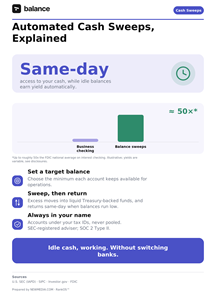
How automated cash sweeps move idle business cash into yield across your existing banks, with same-day access — no switching banks.
Legal Disclaimer:
EIN Presswire provides this news content "as is" without warranty of any kind. We do not accept any responsibility or liability for the accuracy, content, images, videos, licenses, completeness, legality, or reliability of the information contained in this article. If you have any complaints or copyright issues related to this article, kindly contact the author above.
